Ecosystem Epistemology
Ecosystem Epistemology
The network society is under attack.
What is a network, and why does it matter — from the point of view of the attackers first. By knowing how they see it, and knowing how we all know what we know, we can get to the heart of what’s really going on here.
Do you have integrity? Are you sure? How do you even know? And how do you go about verifying the integrity of the networks you belong to, co-operate, or co-own?
These are the questions we have in common. Attackers and beneficiaries of networks alike.
With web3, these questions take on a new significance. We are incentivized to DYOR, and risk losing more than our status, reputation, and bags if we don’t take this epistemological exercise into our own hands.
Epistemology is the study of knowledge, including its nature, sources, and limitations.
It asks questions like:
What does it mean to know something or someone?
How well do you really know them?
What happened between you to give you that knowing?
Can we ever trust each other enough to trade money, power, influence, culture, and all the other things that make us enjoy or dread who we are?
Again, and again, it asks: how do we know?
At the beginning of Daft Punk’s track, “The Grid”, Jeff Bridges’ character Kevin Flynn describes how he sees the circuit boards, microchips, transistors, and electrons that make up the network: “The Grid. A digital frontier. I tried to picture clusters of information as they moved through the computer. What did they look like? Ships, motorcycles? Were the circuits like freeways? I kept dreaming of a world I thought I’d never see. And then, one day… I got in.”
We relish the description for more than the poetry and nostalgia of it. But also, that description lacks something. The network is the people who make it, experience life through it, and benefit from everything it offers.
Attackers of the network society might see more of the threat promised. A fast spreading global undercurrent, shortening the distance for mass hallucinations and disinformation. Fair enough.
But suspicion of other participants in a network, its attackers included, is the easy part. Let’s go deeper.
If you know what you want, and how to ask well structured questions, AI promises to ease most of the fears brought on by the network society and its detractors.
As a synthetic sculptor or chatslinger, you know from direct experience how Stable Diffusion and ChatGPT add value to the work you do, and help refine through each iteration the clarity of ideas and messages contained within.
ChatGPT, like similar conversational LLM interfaces in the early 2023 batch, let you as a creator target your own niche in the mass unbundling of the fashion industry, and every creative industry, by giving you more than a co-author or slot machine text generator. Like a one on one tutor and sparring partner, you get as good as you give, developing your skill at structuring input requests growing with each session. You can do more than rapidly scale up your writing output quantity, alone. Unlike earlier AI text generators, it’s much more than a party trick gimmick. The quality of your writing is refined through repeat conversations and the lessons you learn in how exactly it likes to be asked to produce the co-authored outputs you’re looking for.
Beyond better writing, communications design, content marketing, market research, SEO, social media strategy, and even ideas for your next design… it’s all ready for you to take as far as you will.
Design is more direct. Stable Diffusion continues to grow your capacity as a creator of every kind of art style, apparel design, or complex interactive media scene you can imagine, with each new fine-tuned model and extension released (like the shockingly powerful ControlNet) adding to its already worlds and markets transforming toolkit.
But it’s not all good news these days, is it?
The tendency towards mass hallucination rises from each prompt.
Visually, it’s not so much of a problem yet.
Deepfakes were expected to be the main use of more advanced image and video generators. We have been warned for years. Instead, the bulk of visually creative AI is (predictably, in hindsight) used for serious attempts at design of all kinds, storyboarding, early attempts at film editing and animation, endlessly new models for subtle variations on anime waifus, pushing new and replica styles of art (with the usual debates about what art is)… We’re all generally too busy playing with the new abilities we’ve gained to worry too seriously or to be too prudish about the ways some might abuse their power to draw out their imagination in the shadows. Turns out it’s no worse than what they could already do with graphics tablets, Photoshop, or ink and paper.
Hardware constraints have a lot to do with why we misjudged the ratio between creative liberation and deprivation. When API access, local machines, and cloud GPU hours with enough VRAM are so expensive, who has time to waste on fake stories that fail to entice or drive interest? Like the lessons from founding your own startup, you learn quickly in practice that it takes a lot more effort to get someone to listen to your idea than it’s ever worth erecting barriers to “protect” them from being “stolen”. Generative content is the same.
The world is voracious for good stories. That’s where the work, the art, and the bulk of your time goes. So, keep at it.
It’s in the text itself, the authoritative sounding claims in conversational research, and the questions we’re uncannily nudged to ask again and again — how do we know what we know? — that the risks of the rapid spread of half-false fever memes and cultish beliefs are immediately obvious. At least, it is to anyone who spends more than a few minutes learning to get useful outputs from ChatGPT, Sydney, and the like.
What we need to combat AI generated mass hallucinations is more speech, more expression, better stories, not less.
What we need, it feels obvious to say, is decentralization. Not just of creativity and the tools we use to power it. We need to ditch the old centralized mediums of creative exchange, and replace all content distribution channels with decentralized social media.
Mobile. Personal. Co-Operated. User owned. With creative AI embedded directly into the base metal at the interface and API level.
Built from the ground up with modularity in mind, Lens Protocol has become the leading protocol for the development of decentralized social media apps and platforms. Its web3 social graph lets developers, and by extension creative users of all kinds, navigate the connections and communications between us as if we actually own a stake in such a substantial part of our lives.
A user-owned, open social graph that anyone can plug into is at your finger tips.
It was designed to solve major issues in existing social media networks, where user profiles, friends, and published content were previously locked to the siloed networks which had hijacked enough scale to hold users in fear of losing the years of memories and connections we’ve generated, and thought were actually ours all along.
We have been trapped by ad targeting alogorithms in a zero-sum battle for attention. I lose, you lose, the thin skinned network barons win.
Now, we have a real choice. With Lens, since we own our data as users — and can choose or build in the open market all the tools we could ever need to navigate access — we can bring our social lives to any application built on top of Lens Protocol, or bridge it to other networks that emerge on Ethereum, L2s and beyond. If we don’t like the direction the base infrastructure or ecosystem are taking, we are free to fork any of it and choose our own path to adventure.
With it, we can counter the spread of AI induced mass hallucination by producing more content ourselves.
Meanwhile, legacy Big Tech platforms are shedding employees through rounds of massive layoffs at a record rate. It’s the mass decay of their central premise which their network architectures were built on.
It’s a good time for a reminder here for the entire tech industry, web3 included, of the way William Gibson described one of our founding ideas:
“The future is already here — it’s just not evenly distributed.”
The most trashbin fire lesson in how we know what we know about the unbundled future is unfolding in front of us, and there is so much more to be done than bring popcorn to watch the spectacle. It shows us again why top down control of base level communication infrastructure is not ok. It is playing out in real time, on screens carried in every pocket throughout the net connected world.
Since Elon took over rulership of “the world’s town square”, erratic behavior and edgelord troll decision making are the new normal. Technical “glitches” have included users not being able to post tweets, send messages, follow new accounts, and too many others to count. Third party apps have been cut off from API access, new project rollout has been chaotic at best, and while raising the banner of free speech it’s become clear what that means to Musk is bringing back previously banned accounts for QAnon supporters, neo-nazis, and racists while firing, trolling, and suspending the accounts of many who have been critical, both inside the remaining Twitter workforce and in the media, of his overlordship’s glaring missteps.
Twitter’s days are numbered. And along with it, the same is true at a different rate and for not quite as obviously extreme reasons, for the whole range of web2 legacy social media networks.
So what happens next?
We build.
More specific to the DIGITALAX ecosystem, The Dial builds on Lens as an open source app layer for decentralized social media with a Stable Diffusion canvas integrated directly into the interface. At launch, users will be able to discover, synth, collect, and react to new content, without worry that Elon or other erratic platform barons will suddenly pull the plug on your memories, connections, access, or ability to create.
Shortening the distance between media and retail consumption, indie creative production, and decentralized commerce. That’s what drives this ecosystem.
With the Dial, translating your style and skills into public and private messages that hit better — with special attention to your enhanced ability to design for new fashion lines as vectors for cultural diffusion and status appeal — becomes as uncomplicated as anything you’ve ever done, or wish you hadn’t said, on archaic networks.
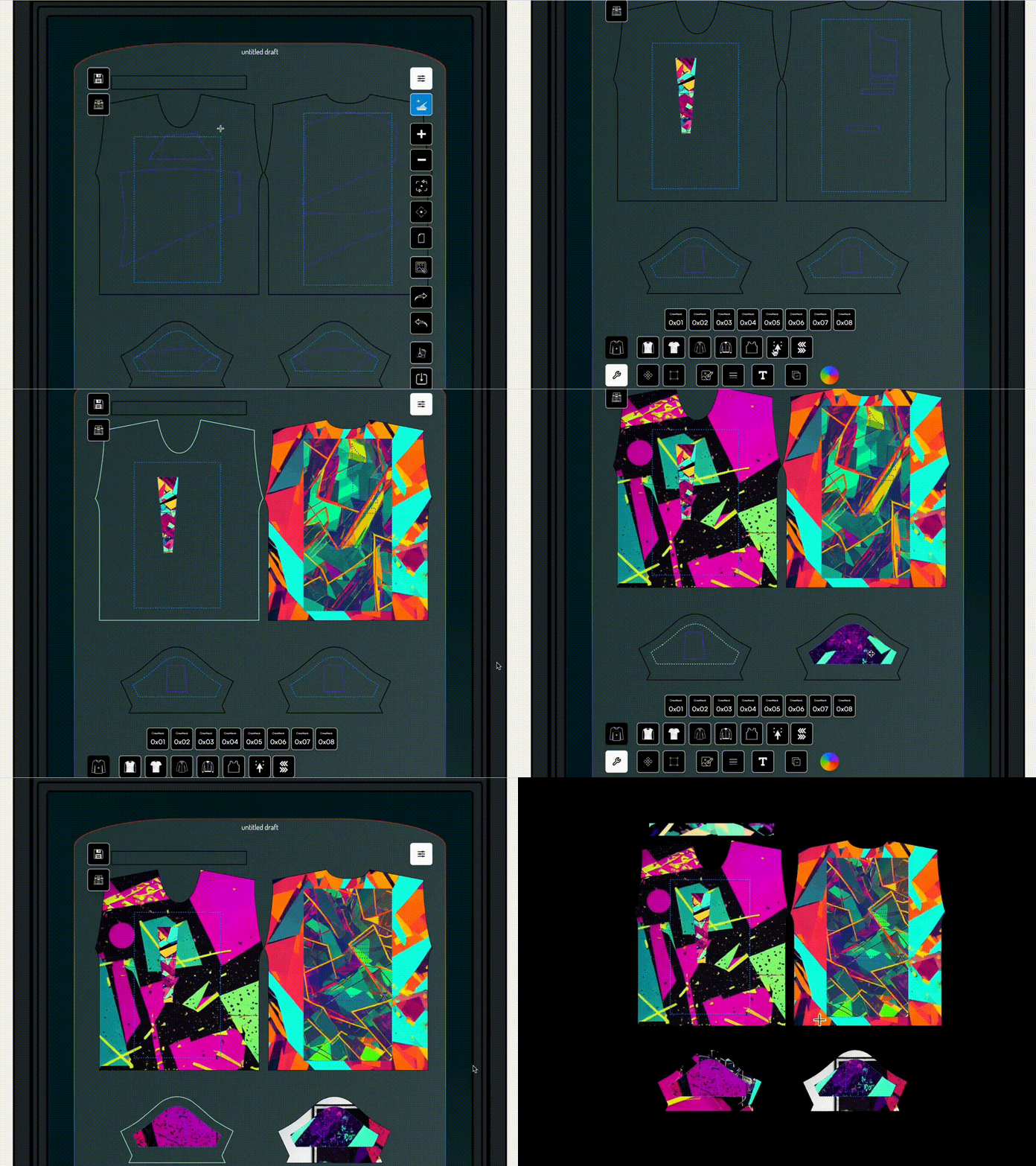
The simplicity of the all-in-one web3 fashion editor & AOP synth templates available at the click of a button within the integrated canvas deserves particular attention. Synth artists, fashion designers and otherwise, can directly combine open source diffusion models with AOP print-on-demand templating systems for direct digital to physical production, with zero upfront inventory cost. Once welcomed into the beta, all you need is a Lens profile and a Stable Diffusion API key.
And it’s all embedded seamlessly into the decentralized social media messaging flow.
It’s one more step, chipping away at the greatest challenge we continue to face as an industry.
“Nobody has made Web3 relevant or accessible for the masses, or really spent the time trying to understand how it solves ‘mass’ market problems or improves consumers’ lives,”
https://decrypt.co/121597/dont-call-it-crypto-how-some-blockchain-and-nft-projects-are-rebranding
It would help to have a more widespread consensus on what NFTs are, how they are useful, and what roles they play in the broader contexts they interoperate with.
It’s useful to simplify and analogize to structural concepts “the masses” are already intimately familiar with. Consumer and creator, alike.
A recent conversation with ChatGPT — which you can roughly reproduce by asking it endless questions about cultural assets, machine parts, software based machines, capital goods, comercial goods, commodities, and reasoning from there — gives a more satisfying analogy.
NFTs are decentralized software based machine parts, often with significant cultural value. For newly emergent net native cultures, communities, and meta-societies they serve essential roles as rallying points and as part of a wide variety of signals relays. They can have as much value, utility, and significance as more commonly recognized cultural assets, like religious icons, ideological samizdat, ancient scrolls, rare artifacts, or archeological hieroglyphs. Often more, even if still nascent, because of their inherent programmability and decentralization reinforcing factors. To the pre-digital portion of the masses, it’s not obvious yet. For those of us who have lived most or all of our lives with digital interactivity as the base layer, it’s hard to miss.
From reliably representing, and simultaneously embodying in spirit and on-chain encoded fact, NFTs replace the role played previously by receipts, stamps, SKUs, supply chain tracking identifiers, in game assets, canvas for art, digital and physical aspects of fashion to the point where the lines between them blur, and an as yet unenumerated list beyond them which we’ve barely begun to unfold.
In the ecosystem, the Genesis NFTs serve an extra role as the inagural proof and statement of alignment with the underlying mission to transform the entire fashion industry through unbundling it, segment by segment and layer by layer. There will never be another first of their kind, at the exact dawn of web3 fashion.
Unless you believe the time machines a few people we’ve known in SF & Silcon Valley think they are working on will ever pan out. (Wish that was more of a joke than it is.)
Returning from timely lols to arguably the most tangible technology in human history, as much as any of the more common candidates, it’s fashion that makes the economy grow. Status appeal, cultural statement, in-group affiliation, protection from the elements, how we carry our most personal keepsakes and tools, and more than anything, how fashion production techniques and machinery have challenged technology to evolve… it’s shaped how we relate to each other, survive, and move forward since our earliest days of being human. Depending on where you draw the line, fashion related technologies are even far older than our species. Stone, wood, or bone tools for the treatment of fabrics, sturdy leaf rope contraptions, and animal skins are the original loot. They have been found with the remains of our ancient pre-human ancestors fossilized records, whoever they were.
Yet, beyond branding and content marketing, fashion NFTs are still poorly understood by the pre-digital masses. Even in web3, it’s “early still”. There’s a lot to be said for the point of view that it will change drastically, and almost all at once seeming, as the web3 narrative shifts more actively from speculation and exhuberance to the every day nuts and bolts of manufacturing and commerce. DIGITALAX has pioneered the engineering, community, and content dev needed to make sense of this new terrain since day 1 of the web3 fashion industry. The fashion NFTs released through the ecosystem so far are as much a testament to that history — a persistent record in the public memory — as they are a guidepost in the new and thoroughly decentralized lands to come.
In a subset of more general fashion and game asset NFTs, the Look NFT collection started as an experiment, inspired by the Loot project, in on-chain composable building blocks. They are meant to distill down to the bare essentials what it means to be a web3 fashion NFT. And, behold, text based scenes can now take on new meaning in a decentralized social media synth canvas mediated metascape. What will the near future bring for Look holders discovering token gated drops or easter eggs while enmeshed in the process of storyboard generation, sourced from their Look book thread lists, in The Dial and other sections of the ecosystem?
As the barriers to mass consumption of media assets give way to the mass generation of indie content for fashion design, commercial marketing, and storytelling in every format, the transformation of interactive decentralized assets for game production and QA lags a bit in the old top down content control, AAA industry overall. PODE is one of the earliest efforts in this ecosystem to develop a unique key to participation and early access in a continuously evolving protoverse of experiences. As The Dial beta nears release, PODE holders gain new ways to unlock limited synth collection drops and access to token gated Lens collection exclusives. New QA pop up quests for decentralized APIs and GPU credit bonuses feature prominently in the post-Dial roadmap.
And what about non-NFT tokens?
(Sidenote: Are linguistic flourishes like that signs that a human is in the co-authorship loop, a shibboleth for the AI age, or would ChatGPT actually be more likely to suggest content that technically translates to “non-non” + “like-for-like” + “token-tokens”? Might want to feed that into your nearest prompt input box.)
With new tools for creation, collection, production, and use, the ways we can streamline storefront activity are also changing. Decentralized commerce is more responsive, flexible, and byte-sized — available on a pocket sized screen, via wall projections, in virtual worlds, or IRL posters and galleries riddled with QR codes, breadcumbing creators and consumers alike to more satisfying finds. DECO serves as a dedicated token for curatorial activity in this ecosystem.
As the picture becomes clear, of tools given shape in software and through on-demand, up front inventory-less fulfillment for indie creators, another set of questions start to rise. How can creators operate such a vast variety of synth machines in a more consistent, standardized, decentralized and open source set of interface layers?
Generative AI models may be open source and widely available now, but the infrastructure needed to run them is far from it. Any sufficiently advanced technology for ultra low latentcy, persistent connectivity at any distance worth the name “The Metaverse” will guzzle far more hardware and bandwidth besides.
It’s hard to imagine how much good can be done with AI, with all-in-one creative editors, and with the continuing miniaturization of circuits, chips, and machine parts. The unbundling of the fashion industry, and the spillover of benefits to every other industry beyond it, will stall out without universal access to simple machine operation interfaces that are decentralized from the start to ensure their persistent integrity, and all of ours. It’s a key part of a comprehensive defense against economic censorship.
W3F is a dedicated virtual interface token for operation of the on-demand fashion synth economy.
To bring it all together, MONA remains the all-in-one dedicated ecosystem token for web3 fashion and the unbundling of fashion as a whole. As we continue to build on NFT marketplace contracts, extend functionality into decentralized social media through The Dial, provide new storefront interfaces for creators in virtual, IRL, and latent spaces, and go forward into more open architectures for microfactory co-op development, with all the decentralized APIs for AI synth compute you need, MONA serves a crucial role for every part of the ecosystem.
The simplest of them all might be the signal it carries — the fashion statement it makes as a net native cultural asset that is simultaneously rare and one of many. It says: “The world as it’s been is wondrous, fantastical, and also unacceptable.”
Entire industries, markets, and societies are desperate for more reliably persistent methods to regain their integrity. Climates demand sustainability. Consumers demand creative choice, and the ability to design, manufacture, collect, and trade any and all of it, ourselves. We can have it all, but only if we ask better epistemological questions.
Or, in short: “How do you know you need decentralizaton, and all the dedicated machine parts needed for it to work, until you do?”
Stay Up to Date with Web3 Fashion:
• Lens
• Github
• Flagship
• Docs