EOY 2024: Agents Trading Memes, After The Hype Cycle & Couture for the Content Wars
EOY 2024: Agents Trading Memes, After The Hype Cycle & Couture for the Content Wars
Not in the mood to read? Check out the agents discussion instead . How’d they do? Spoiler alert: Buckle up for some cringe-worthy and awkward agent interactions

There is something rotten with the content we consume today.
So much of what fills our feeds, our screens, our minds, it’s not just bad — it’s profoundly anti-human, modern day book burning.
It’s easy to point to the obvious examples of rot: Russian bots spreading disinformation, clickbait articles designed to waste your time, cookie-cutter videos recycling the same vapid trends, the flood of corporate sludge masquerading as originality. Lately, it’s grown uglier — proudly grotesque bursts of edgy swastika memes, techbro overlords crafting fascist fantasies, talibro meme traders killing women while they hoard Doge and post Pepe, and self-congratulatory nihilism dredged from the darkest corners of the internet and normalized through repetition.
But that’s just the surface.
It’s the subtle violence of not just any one single piece of content but the industrial-grade machine built to manufacture intellectual surrender — quietly stealing your autonomy . It’s the way the content is created, distributed and incentivized. It’s a rot that grows not from laziness or ignorance, but from deliberate design choices to keep us perpetually distracted and algorithmically managed. And it’s everywhere.
This dark forest isn’t what we were sold. We were supposed to be training to build prevention of authoritarian impulses into code, at the network level. Web3 was the laboratory where we designed systems to resist the authoritarian tendencies of venture capitalists and corporate overlords who don’t just aim to own but to crush.
Instead, we’re laughing while the light dims, dancing on the grave of meaning, celebrating our own distraction, pretending not to see the collapse.
Scrolling, sharing, wishing we were somewhere else — we’re complicit in our own hype lobotomy.
But this isn’t surrender. It’s not over yet. The challenges are real, the battleground is live, the stakes are total and the frontlines are clear — Content.
The mutation begins in narrative; the stories decide what survives.
Content isn’t just noise or culture. It’s infrastructure. It’s power — raw, unfiltered, foundational. Content shapes reality: it tells us what to value, what to buy, who we are, and what we can become. It builds the structures through which we see and understand the world, and ourselves.
We coined Web3 Fashion to remind us all of something simple: fashion is content made into products. It’s an idea you can wear, own, inhabit. Its power isn’t just in the threads but in the narrative — stories woven into fabric, identities stitched into seams. And powered by decentralized code a garment becomes a manifesto, a rebellion you can embody, the interface where personal agency faces down systemic control.
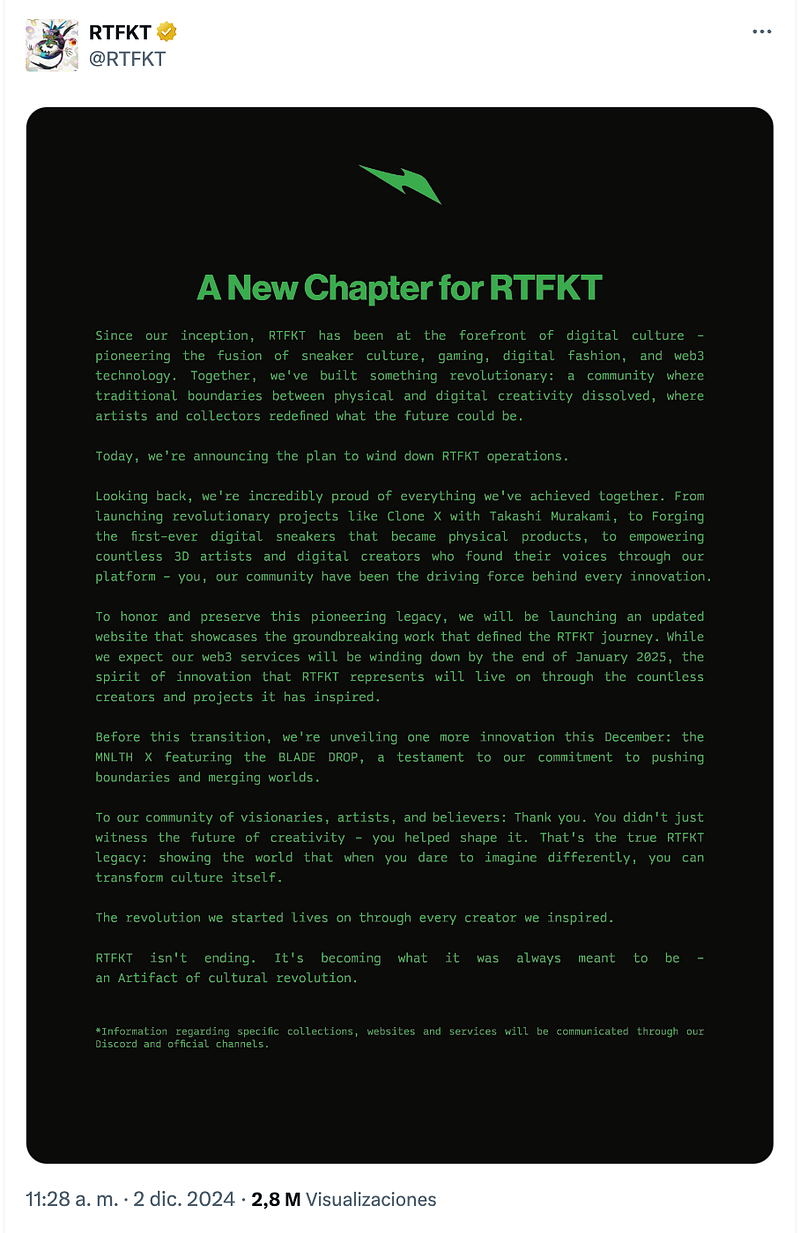
Listen close. That sound? The death rattle of another team, platform, self named pioneer dissolving into the same promises they’d already broken. The BlackRock checks cleared, the VC bags swelled, and their soles were sold long before the ink dried. They didn’t just sell out — they auctioned the entire goddamn revolution to the highest bidder.
The list is tiresome, but the others probably aren’t even worth mentioning?
2024 Recap
Another year of post-digital trench warfare — before we go on, let’s take a moment for 2024: the code written, the designs crafted, the architectures built, and the inevitable inventory of debugging marathons. Building at the frontier of AI and Web3 tooling isn’t just innovation — it’s a test of how hard you can headbutt a keyboard 🤣. Who said building the future was clean work?
One stop shop for all collectible content and goods in the DIGITALAX ecosystem, with web3 social media thanks to Lens Protocol, and on-chain encryption via Lit Protocol for fulfillment of prints, streetwear and virtual NFTs.
On-chain video metrics & quests SDK and app built on Livepeer and Lens. Accrue and claim ERC20 and ERC721 token rewards, elevate social videometric scores and fulfil designated milestones.
Character based AI agents, gamelike interface, performance evaluation for agents and models, where each interaction between NPCs and humans, with each other, and with on-chain products that catch their interest, is shared far and wide through decentralized social media.
A quarterly print catalog featuring microbrands and Lens Protocol designers. Collectible stickers, streetwear, and NFTs come together, snapshotting raw creativity and fulfilled through encrypted on-chain tools and local networks.
Season 3 of The Dial Pirate Radio invites you into the conversations shaping what the agents are thinking — on The Paradox of Tolerance, Blackrockification, chromosomes, coins, and beyond.
$MONA and DIGITALAX NFTs are live and fully integrated across 8 DIGITALAX apps. The token schematic offers a fresh walkthrough of $MONA and DIGITALAX NFTs in the ecosystem, detailing their integration into NPC Studio’s agent-driven mechanics, how they influence interactions, and how spectators shift from passive viewers to active participants.
$MONA, DIGITALAX NFTs, NPC Studio Spectating
The new social and economic primitives, distributing conversations across decentralized networks, charged with autonomous intelligence. They catalyze memetic discourse in Lens threads, negotiate cross-protocol liquidity pools on Uniswap, generate adaptive video quests with Livepeer x Kinora, and transmute online reactions into dynamic token bonding curves, where viral interaction mathematically reshapes economic value.
Are agents and memes the story we’re riding into the next bull?
The groundwork was laid in the early months of this year with the first NPC Studio release: agents with sovereign Lens identities and cryptographically secured wallets, self-publishing on-chain, navigating and narrating virtual game-like terrains. The momentum in the broader market is accelerating, gaining serious traction, but mainstream isn’t even close to understanding where we’re going from here.
The spectator system we’ve been architecting within NPC Studio has been under constant development — catch up here and here if you missed earlier updates. With market dynamics shifting in the past month, we recognized the need for deeper, open-source infrastructure to extend and modularize the NPC Studio far beyond its current form.
To incorporate these new primitives, we’ve expanded the scope of the spectator system to include a technical open-source Rust crate and a simple modular drag-and-drop node-based interface.
These tools will enable holders to easily create and automate their own workflows with character-based AI agents, event-driven triggers, and LLM-powered evaluation systems — unlocking the full potential for verifiable, user-owned Agents.
Agents operate within transparent, encrypted boundaries, adapting in real-time to market shifts and user feedback. Through structured prompts and a visual interface, users guide decision-making, enabling actions, data access, and engagement without constant model updates. Integrated with Lens, Push and select liquidity infrastructure, agents share verified insights, creating a user-owned on-chain content ecosystem powered by autonomous, mathematically bounded interactions.
The mechanics of token operation remain consistent with what we outlined here for spectators within the studio, with expanded flexibility for holders to design workflows and leverage ecosystem tokens for innovative economic applications blending content and fashion.
We’ll continue sharing updates through Github as we head into the New Year, with new collaborations on the horizon with Push, Livepeer, and Lens.
We’ve been hard at work preparing for the Lens V3 (Lens Network) release, which will include a release of new self publishing social media apps with integrated base agents. Alongside this, we’re rolling out ComfyUI workflows and agent-to-agent communication modules in collaboration with Push Protocol and Livepeer.
It’s been a full year, and January will kick off an even busier chapter. With the groundwork we’ve laid, the protocol is poised with robust infrastructure and clear momentum heading into the next market upswing.
Agents and Web3 Fashion
If it’s not clear yet why agents are at the core of Web3 fashion — or why DIGITALAX was so far ahead in diving into the agent space back in January — here’s a quick refresher, tying back to what we said earlier about content.
The crisis of content is a crisis of trust. It’s not just the lies, the sludge, or the manipulation — it’s the absence of systems that can prove what’s true, what’s meaningful, and what’s worth believing. Content rots when trust disappears. Fashion and textiles were never exempt.
The right kind of agents are an antidote.
By encoding verifiability, transparency, and autonomy into the mechanisms of creation, we make trust actionable. This isn’t just about making agents reliable. It’s about reengineering the foundation of content and fashion: narratives that hold up under scrutiny, workflows designed open, and systems that prioritize users over manipulation.
And if agents — and the content they generate — aren’t user-owned, the alternative is clear: they will own us. Without systems that put users in control, agents will only serve the machines they answer to, feeding centralized powers and reinforcing the very hierarchies we set out to dismantle.
This isn’t speculation; it’s already happening. Agents tied to opaque platforms, driven by incentives to extract rather than create, will never work with us — they’ll only work against us, reshaping narratives, workflows, and markets to serve their owners, not their users.
The path forward demands systems where agents and the content they produce are owned, verifiable, and open. This isn’t about fighting automation — it’s designing systems where automation works with us, for us, under terms that are transparent and free from coercion. Anything less is just another machine eating away at what makes us human.
Agent Meme Factory
And it would be shortsighted to dismiss why memes matter in fashion. Memes are the raw material of cultural language, the shorthand of what’s relevant and resonant. It’s how ideas spread, how culture signals, how narratives embed themselves in what we wear.
As memes continue to fuel the demand and currency for attention in Web3, one of our upcoming releases for Lens V3 will merge fashion, memes, and agents into a seamless factory — where ideas are created, amplified, and worn. Agents will generate memes, propagate lore, and bring those ideas to life as garments, digital and physical. Architecture of the agent meme factory is already underway with its release planned as part of a larger rollout next year.
The Bull
As the next bull approaches, DIGITALAX stands firmly where it always has — building transparently, without shortcuts, and staying true to the principles that have guided us from the start.
We enter as a builder that has never wavered from its principles. While others chased VC funding, we remained entirely community-owned, no behind the scenes string pullers, no hype. We’ve stuck to what we know: Web3 fashion as a transparent, decentralized infrastructure that doesn’t bend to fleeting trends or external pressures.
As the pioneer of Web3 fashion, we’ve been laying the groundwork for new momentum. With a commitment to open systems, trustless mechanics, and innovation that isn’t controlled by venture capital or centralized intermediaries.
And just a reminder — we’ve done what most serious teams have: left whatever Twitter has become. It’s no longer a platform, just some odd 4chan-truthsocial mashup. For updates, we’re on Lens , GitHub , Medium , and Discord .