Keymasters Code PKPs: LitListenerSDK, Encrypted NFTs & The Rebel Garment of the Digital Age
Keymasters Code PKPs: LitListenerSDK , Encrypted NFTs & The Rebel Garment of the Digital Age

The basement was dim, lit only by the pale glow of chunky CRT monitors and the occasional flicker of a fluorescent bulb. A motley crew of hackers, coders, and free-thinkers huddled around makeshift tables cluttered with soldering irons, circuit boards, half-eaten pizza. And T-Shirts.
No, really. A whole tonne of T-Shirts.
Tonight was special. A collective sense of urgency filled the room. The Crypto Wars had begun.
A math equation treated like an AK-47. Lines of open source code now legally equivalent to lethal weaponry. Penalties of up to 10 years in prison and fines up to one million dollars.
Encryption algorithms freshly stamped as munitions.
The printer hummed diligently from the corner of the room, etching line after line of forbidden RSA code onto the back of each cotton black shirt. Thousands of T-Shirts.
The fight for freedom of speech in software, the right to publish it and the right of anyone to use end-to-end encryption.
Does this Tornado of usurpation sound familiar?
Without private and secure tools for autonomy, without infrastructure and mechanisms that safeguard an individual’s ability to operate freely within a network, without immutable cryptographic assurance, without webs of trust with unhijackable corridors, without personal autonomy enabled at the epicenter of all interactions, without encryption— the grand promise of a decentralised future doesn’t exist.
Where did all the cypherpunks go?
LitListenerSDK
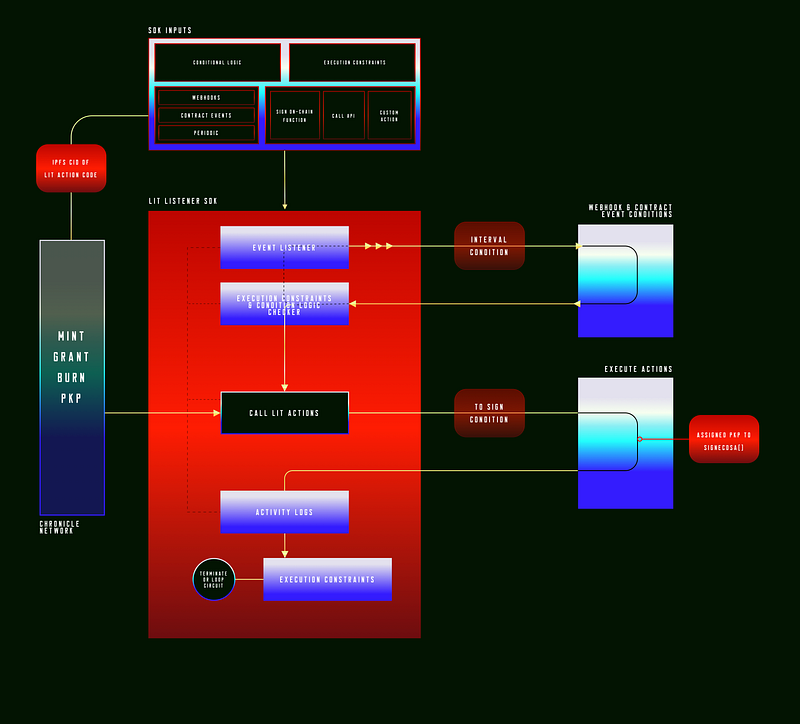
This Summer we’ve collaborated with Lit Protocol to build out the LitListenerSDK — an open source typescript SDK, compatible with node and browser, to automate responses from webhooks, subscribed on-chain events and intervals through triggered callback functions and the use of Lit Protocol PKPs.
The SDK combines event listening, conditional signing, autonomous functions and PKPs to translate threshold cryptography into an easy to use interface for applying advanced on chain encryption across an abundance of web3 social apps and infrastructure.
The LitListenerSDK is designed around the principle of conditionally pre-approved chain reactions with account abstraction . You have a series of things you want to do in an encrypted and decentralized context. But you shouldn’t need to be hovering over those actions to make sure they happen, when and how they are supposed to.
Instead of asking you to juggle terms like “wallets” and “accounts”, it presents a simple platform where you can manage your assets, communicate with others, and maintain privacy.
• Supply Chain Management: Listen for a smart contract event, signaling when a shipped item has reached its destination (verified by a trusted third-party oracle). If the item ID matches the expected value, the SDK triggers an on-chain function. It releases payment to the supplier, and updates the product’s status in the supply chain smart contract.
• Gaming / Collectibles: Listen for events which herald fully autonomous game worlds. Signaling when a player has achieved a milestone, or found a rare item, is just the start. When events are detected, it can trigger an on-chain function that mints unique NFTs, and assigns them to pre-approved addresses for players or spectators. Off-chain, you can use the SDK to send a notification to players, and update their leaderboard status.
• Web3 Fashion: When a new fashion line, or streetwear drop, is released, be on the lookout for it ahead of time. Trigger an on-chain function to place a bid, or make a direct purchase on your behalf, if items in the collection match the pre-approved preferences set by the collector.
• DeFi: The circuit you’ve set through the SDK listens for a specific webhook event related to market prices (from a trusted API). When the price of a chosen token satisfies a pre-approved threshold, the SDK fires an on-chain function. It triggers a trade, or a series of them, on a decentralized exchange.
• Web3 Social Media: Listen for events related to new posts, new likes, and other activity, from accounts you set as worth following more closely than a default friend or follow button can offer on its own. When a new event is detected, it can trigger an on-chain function to tip a creator with tokens, if the content matches the user’s pre-approved interests, or set off more elaborate chain reactions.
See the docs and npm package for installation.

The LitListenerSDK lets you mint PKPs on Lit Protocol’s Chronicle network and verifiably assign these PKPs to Lit Actions to set and run on-chain functions (with Javascript).
You can create your own PKPs on Lit Protocol’s Chronicle network. PKPs are self-contained tools combining programmable logic (hence the name) with conditional signatures that you can use to approve transactions, and other messages, online. And since almost everything is connected online today, that means IRL too.
What makes PKPs special is that they aren’t made or maintained by just one entity. They’re the result of teamwork in the Lit network, with multiple nodes contributing a piece of the keys, but no one having the whole thing. It’s like everyone has a part of the secret recipe, but no one can make the dish on their own unless they meet the conditions spelled out by your pre-approval.
PKPs are managed by a unique token on the Chronicle network. If your wallet holds this token, you can ask the Lit network to combine the key pieces and sign any transaction or message on your behalf.
Lit Actions are like a task list for your PKPs. Written in JavaScript, they tell your PKPs what transactions need to be confirmed. They’re designed to work on any network where Lit Protocol operates, allowing you to perform tasks across different systems with the same set of instructions.
In our case, we pair Lit Actions with PKPs to manage our decentralized interactions. This allows us to operate smoothly and securely, without the need to know the nitty-gritty of each task.
SDK Architecture
No-Code Interface
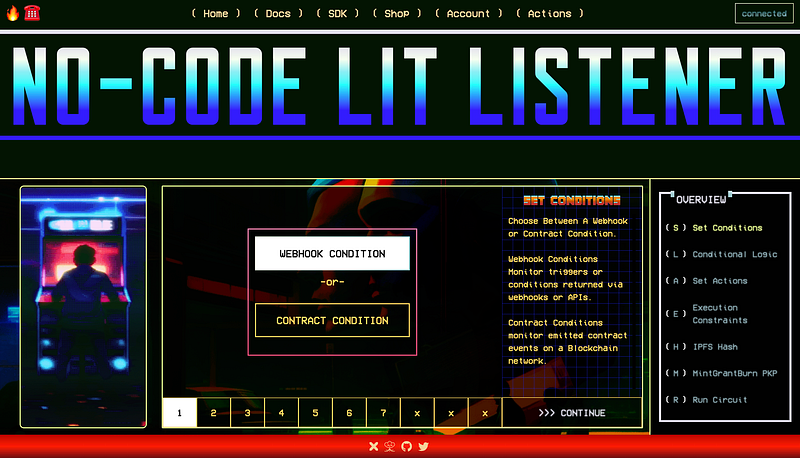
If you’re not feeling quite ready to go full development mode, check out the no-code interface here for a simpler start.
Lit Listener Storefront
And because anon insiders wear streetwear and cypherpunks print t-shirts, too, we’ve handcrafted, designed, manufactured and released a limited edition LitListener collection, available at The Listener Storefront. Decrypt your wardrobe here , fulfilled locally in NYC @ The Manufactory .



We’ve paid special attention this year to integrate PKPs and Lit Actions throughout almost all of our current ecosystem dApps. With the launch of LitListenerSDK, these features are now actively enhancing Chromadin, Kinora, and Legend.
If you’re eager to contribute to the SDK or want to chat more about applied decentralised social cryptography, see the contribution step-by-step here and connect with us on Lens.
Stay Up to Date with Web3 Fashion:
• Lens
• Github
• Flagship